
How to Create a Compliance Calendar for Institutional Reporting
A compliance calendar helps Florida private higher education institutions stay ahead of reporting deadlines, renewals, internal reviews, and document updates. Without one, even well-run schools can miss recurring obligations or rush through important filings at the last minute.
For institutions overseen by the Commission for Independent Education, a compliance calendar is not just helpful; it is a practical tool for managing the many moving parts of licensure and institutional oversight.
Start with recurring obligations
The first step is to identify every recurring task the institution must complete. This may include annual reporting, policy reviews, catalog updates, program reviews, faculty file audits, and internal leadership check-ins.
Once these items are listed, place them on a twelve-month calendar so the institution can see the full cycle instead of reacting to one deadline at a time. That view helps leaders spot conflicts and plan ahead.
A sample twelve-month cycle
Institutions do not all run on the same calendar. A school licensed in March works on a different rhythm than one licensed in September, so the most durable approach is to build the cycle around the institution’s own renewal date rather than around the calendar year. The table below shows how a full cycle might be distributed, with month one beginning the first full month after renewal.
The obligations listed are illustrative of the categories institutions commonly track. Each institution should confirm its own requirements, dates, and reporting expectations.
| Cycle Month | Recurring Obligation | Type | Typical Owner |
|---|---|---|---|
| 1 | Calendar review and assignment of owners for the year ahead | Governance | Executive leadership |
| 2 | Catalog and catalog addendum accuracy review | Academic | Chief academic officer |
| 3 | Faculty credential and personnel file audit | Recordkeeping | Registrar and human resources |
| 4 | Program review (rotating schedule by program) | Academic | Program directors |
| 5 | Policy manual and procedure review | Governance | Executive leadership |
| 6 | Student complaint and grievance log reconciliation | Recordkeeping | Student services |
| 7 | Financial documentation and surety instrument check | Regulatory | Business office |
| 8 | Advisory board meeting, agenda, and minutes | Governance | Board liaison |
| 9 | Website, advertising, and disclosure accuracy review | Regulatory | Compliance and marketing |
| 10 | Institutional effectiveness and outcomes data compilation | Academic | Assessment lead |
| 11 | Renewal package drafting and internal review | Regulatory | Compliance lead |
| 12 | Final verification and submission | Regulatory | President or designee |
Spreading obligations across the cycle this way keeps any single month from carrying the weight of the entire compliance year. It also makes staffing gaps visible in advance, since a month with three owners in three different offices is a month that needs coordination rather than reminders.
Assign Responsibility
A compliance calendar only works if each task has an owner. Naming one is a start, but most compliance tasks pass through more than one set of hands, and the institution should identify who is responsible for preparing, reviewing, approving, and submitting each item. Recording those roles in writing prevents the common problem of “everyone thought someone else handled it.” The table below shows one way to lay them out.
| Task | Prepares | Reviews | Approves | Submits or Publishes |
|---|---|---|---|---|
| Annual report | Compliance lead | Chief academic officer | President | Compliance lead |
| Catalog update | Registrar | Chief academic officer | President | Registrar |
| Faculty file audit | Human resources | Compliance lead | Chief academic officer | Retained internally |
| Program change | Program director | Curriculum committee | President or board | Compliance lead |
| Policy revision | Policy owner | Executive team | Board | Retained internally |
| Renewal package | Compliance lead | Executive team | President | President or designee |
Titles will differ from one institution to the next, and a smaller school may see the same person appear in two columns. That is workable. What is not workable is the same person appearing in all four, since it removes the second look that catches errors before they leave the building.
Build in review dates
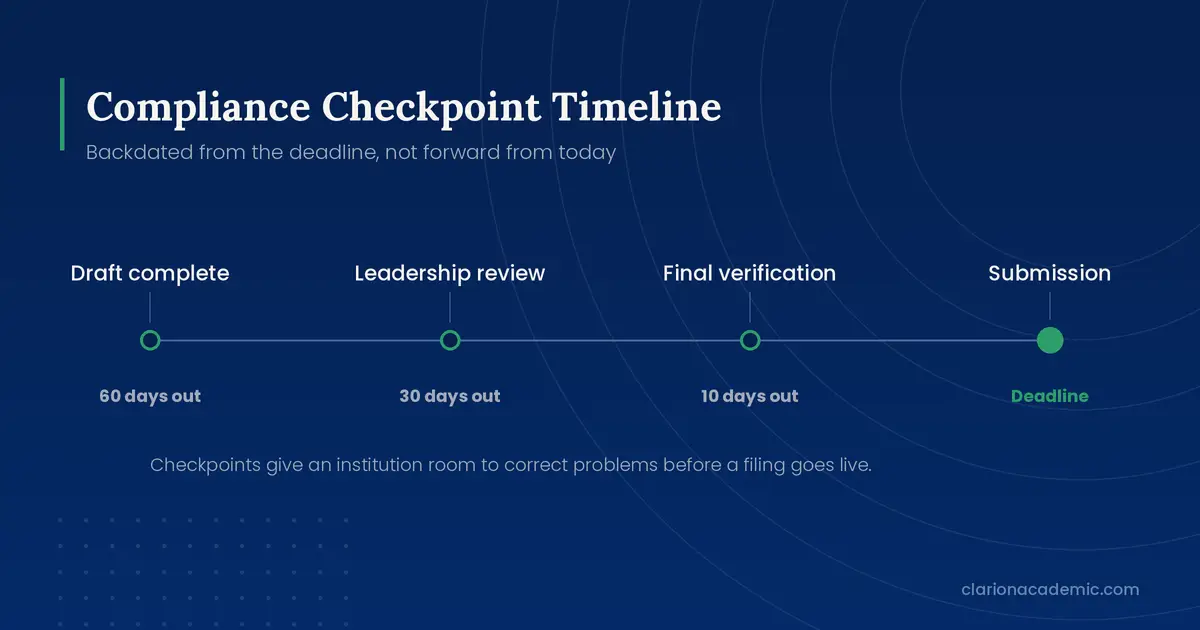
Deadlines should not be the only dates on the calendar. Institutions should also add internal checkpoints for draft review, leadership approval, and final verification. Those checkpoints give the institution time to correct problems before a submission or publication goes live. They also reduce the chance of last-minute errors that could affect compliance.
A practical way to set those checkpoints is to count backward from the deadline rather than forward from today. Backdating makes the available working time visible immediately, and it exposes a compressed schedule early enough to do something about it.
Keep it visible and current
A calendar should be shared with the people who need it, not buried in a folder no one checks. Leadership, compliance staff, academic administrators, and operational managers should all understand the parts of the calendar relevant to them.
It should also be updated regularly as programs, staffing, or reporting obligations change. A stale calendar is almost as risky as having no calendar at all.
Final thought
A strong compliance calendar turns reporting from a crisis into a routine. For Florida private institutions, that kind of structure supports better planning, fewer surprises, and a stronger licensing posture overall.
Clarion Academic Consulting supports private higher education institutions in Florida with CIE licensure readiness, compliance gap analysis, documentation alignment, and governance and academic recordkeeping. If your institution is working through a licensure, reporting, or documentation question, schedule a consultation.
Next: What Documents Institutions Should Keep Ready for Review
How to Create a Compliance Calendar for Institutional Reporting

This content is provided for general informational purposes only and does not constitute legal, regulatory, or accreditation advice, nor does it create a consulting relationship. Institutions remain solely responsible for their own compliance decisions, and Clarion Academic Consulting assumes no liability for actions taken in reliance on this material. Statutory and rule references are summarized and may not reflect the full text or most current version; institutions should consult the Florida Department of Education, the Commission for Independent Education, or the relevant accrediting agency directly. Timelines, deadlines, and fee amounts are current as of the date of publication and are subject to change without notice. Descriptions of processes are illustrative and are not intended as procedural instructions; requirements vary by institution, program, and circumstance.
Tags: CIE Licensure, Commission for Independent Education, Compliance Calendar, Florida Higher Education, Higher Education Compliance, Institutional Reporting, Recordkeeping, Regulatory Compliance